
embrem.com
Last scanned just now
53
100
Rank: 664 of 973
Decent
This website scored 53 out of 100 - 25 of 49 checks passed, with 24 issues identified for improvement.
This is the number of external JavaScript files, images, and CSS stylesheets loaded by the page - each one is a separate request the browser has to make, which is why fewer, combined resources generally load faster.

Actor Essentials
1 high priority 2 medium priorities
Demo Reel
No demo reel or video embed was found.
An embedded YouTube or Vimeo reel gives visitors a fast, no-download way to see you act. It should be one click from the homepage, not buried in a separate media page.
IMDb Link
No link to an IMDb profile was found.
A working link to your IMDb page is the industry-standard credibility check - it lets anyone verify your credits in one click without you having to list them all on your own site.
Headshot / Photo
A prominent headshot or photo was found.
image present, size unconfirmed
A clear, recent headshot should be visible without scrolling. Casting directors and agents decide in seconds, and a missing or hard-to-find photo is often an instant pass.
Representation Contact
No agent/manager representation contact info was found.
We check the homepage and, if there's a link to a Contact page, that page too, for phrases like "Agent:", "Manager:", or "represented by". If your representation is listed under a different heading or page, adding a clear "Agent:" / "Manager:" label near the contact info will help this pass.
SEO
2 high priorities 2 medium priorities 5 low priorities
Title
The title tag is missing, empty, or poorly sized.
Embrem
The title tag is the HTML element that specifies the title of a webpage. It is displayed at the top of the browser tab, in search results, and in bookmarks. Aim for a unique, descriptive title between 10 and 70 characters that includes the name and what the page is about.
Learn more
Google
Robots.txt
The webpage can be accessed by search engines.
text/plain
robots.txt tells search engine crawlers which parts of a site they may access. It should be served as plain text and should not block pages you want indexed.
Learn more
Google
Favicon
The webpage has a favicon.
img/favicon.png
The favicon is the small icon shown in the browser tab, bookmarks, and sometimes in search results. Every page should link one via a <link rel="icon"> tag.
Learn more
Google
Noindex
The webpage does not have a noindex tag set.
index,follow,archive
A noindex meta tag explicitly tells search engines not to show this page in results - often left over from a staging site. Remove it if you want this page to be found on Google.
404 Page
The website does not return a proper 404 status for missing pages.
200
When a page does not exist, the server should respond with an HTTP 404 status. If it instead returns 200 (a "soft 404"), search engines may index broken URLs as if they were real pages.
Headings
The heading structure could be improved.
H1: 0
H2: 0
H3: 0
H4: 1
H5: 0
H6: 0
H2: 0
H3: 0
H4: 1
H5: 0
H6: 0
A page should have exactly one H1 (the main heading), with H2-H6 used underneath it to structure content in a logical hierarchy. This helps both search engines and screen readers understand what the page is about.
Learn more
MDN
Language
The webpage is missing a declared language.
The lang attribute on the <html> tag tells browsers and search engines what language the page is written in, which affects screen readers, translation prompts, and search targeting.
Canonical Tag
No canonical tag was found.
A canonical tag tells search engines which URL is the "real" version of a page when the same content is reachable multiple ways (with/without www, trailing slash, tracking params). Without one, search engines may split ranking signal across duplicate URLs instead of consolidating it onto one.
Learn more
Google
In-page Links
The number of links on the webpage is okay.
External: 4
Internal: 17
Internal: 17
Pages with an unusually high number of links can dilute the value passed to any single link and may look spammy to search engines.
Image Keywords
Some images are missing alt attributes.
Total: 6
Missing Alt: 6
Missing Alt: 6
The alt attribute describes an image for search engines and screen readers. Every meaningful image (headshots especially) should have a short, descriptive alt text - not just the filename.
Learn more
Google
Apple Touch Icon
No apple-touch-icon was found.
Separate from the favicon, this is the icon used when a visitor adds the site to their iOS home screen, and by some chat apps (Slack, Discord) generating link previews. A 180x180px PNG linked via rel="apple-touch-icon" covers this.
Content Keywords
The content has relevant keywords.
feedparser, january, embrem, films, lost
Search engines look at the words that appear most often on a page to understand its topic. If no clear keywords emerge, the page likely has too little text, or the text is too generic to signal what it is about.
Meta Description
The meta description tag is missing or empty.
The meta description is a short summary shown under the title in search results. It does not directly affect ranking, but a clear, compelling one (roughly 50-160 characters) improves click-through from search.
Learn more
Google
SEO Friendly URL
The URL is SEO friendly.
http://www.embrem.com/
Clean URLs without query strings or underscores are easier for both users and search engines to read. Use hyphens instead of underscores, and keep URLs short and descriptive.
Keyword Consistency
The page's top keywords are not well reflected in the title, description or headings.
Top Keywords: feedparser, january, embrem, films, lost
Matched In Title Desc Headings: embrem
Matched In Title Desc Headings: embrem
The words that appear most in the body content should also show up in the title, meta description and headings - that consistency is a strong, simple relevance signal to search engines.
Performance
1 medium priority 2 low priorities
DOM Size
The DOM size is optimal.
92
A very large number of HTML elements makes the page slower to render and to update with JavaScript. Simplifying nested wrapper divs and page-builder bloat usually brings this down.
JavaScript Defer
Some JavaScript resources are missing the defer attribute.
5
Without defer or async, the browser stops rendering the page to download and execute each script tag in order. Adding defer lets the page render immediately while scripts load in the background.
Load Time
The webpage loads quickly.
0.43
Slow load times increase the chance a visitor - or a casting director skimming dozens of sites - leaves before the page even finishes loading. Aim for under 2 seconds.
Page Size
The size of the HTML webpage is reasonable.
7.0 KB
A large HTML document (usually from oversized inline scripts, styles, or uncompressed markup) takes longer to download and parse before the page can render.
Image Format
Some images are not using modern formats (AVIF/WebP).
6
JPEG/PNG/GIF are older formats. Modern formats like WebP and AVIF produce visually similar images at a fraction of the file size - especially valuable for headshot-heavy actor sites.
HTTP Requests
There are a reasonable number of HTTP requests on the webpage.
Images: 6
Javascripts: 5
Stylesheets: 4
Javascripts: 5
Stylesheets: 4
Every script and image is a separate network request. Combining/lazy-loading resources and trimming unused scripts reduces the number of round-trips needed to render the page.
JavaScript File Count
A reasonable number of separate JavaScript files are loaded.
5
Even deferred scripts each cost a connection and parse time. Bundling many small JS files into fewer, larger ones (a build step most site builders do automatically) reduces overhead.
Text Compression
The HTML file is not compressed.
Enabling gzip or brotli compression on the server can shrink HTML/CSS/JS transfer size dramatically, speeding up load time for every visitor at essentially no cost.
Security
1 high priority 2 low priorities
HTTPS Encryption
The webpage does not use HTTPS encryption.
http://www.embrem.com/
HTTPS encrypts traffic between the visitor and the server. Browsers actively flag non-HTTPS sites as "Not Secure", and Google uses HTTPS as a ranking signal. Most hosts offer free certificates via Let's Encrypt.
Flash Content
No Adobe Flash content was found.
Adobe Flash Player was discontinued at the end of 2020 and is blocked by every modern browser - any remaining <object>/<embed> pointing at a .swf file is now completely invisible to visitors and should be replaced with an HTML5 video embed.
Mixed Content
There are no mixed content resources on the webpage.
0
When an HTTPS page loads an image, script, or stylesheet over plain HTTP, browsers block or flag it. Update those resource URLs to https:// (or protocol-relative //).
Plaintext Email
No plaintext emails were found exposed on the page.
Email addresses written directly in the page HTML get harvested by spam bots. A contact form, or an obfuscated/JS-rendered address, avoids exposing it directly.
Server Signature
The webpage has a public server signature.
cloudflare
The Server response header can reveal the exact web server software and version in use, which makes it slightly easier for an attacker to target known vulnerabilities. Most servers let you suppress or generalize this header.
Unsafe Cross-origin Links
The webpage has links with target="_blank" missing rel="noopener".
4
A link that opens in a new tab (target="_blank") without rel="noopener" lets the destination page access and redirect the original tab via window.opener - a known phishing vector. Add rel="noopener noreferrer".
Learn more
MDN
Miscellaneous
3 medium priorities 3 low priorities
Social Links
The webpage links to social profiles.
Twitter.com: 1
Youtube.com: 1
Facebook.com: 1
Youtube.com: 1
Facebook.com: 1
Linking to active social profiles (Instagram, TikTok, etc.) gives visitors - and casting directors researching you - another way to verify you're a real, active professional.
Character Set
The webpage has a charset value set.
utf-8
Declaring a charset (almost always UTF-8) tells the browser how to decode the page's bytes into text, preventing garbled characters especially in names with accents.
Sitemap
A sitemap was found.
http://www.embrem.com/sitemap.xml
A sitemap.xml lists every page on the site so search engines can discover them efficiently, especially pages with few internal links pointing to them (like an older press or credits page).
Learn more
Google
Open Graph Image
No Open Graph image was found.
The og:image tag controls the preview image shown when a link is shared on iMessage, Instagram, Facebook, or in a text message. Without one, shared links show a blank or generic placeholder instead of a headshot - a missed first impression.
Learn more
Open Graph
Inline CSS
The webpage does not rely heavily on inline CSS.
1
Heavy use of style="..." attributes bloats the HTML and can't be cached the way an external stylesheet can. Moving repeated styles into a CSS file keeps pages smaller and easier to maintain.
Dublin Core Metadata
No Dublin Core metadata was found.
0
Dublin Core tags (dc.title, dc.creator, etc.) are an older metadata standard still used by some library, archive, and academic indexing systems. Low impact for most sites, but a nice-to-have.
Meta Viewport
The webpage has a meta viewport tag set.
width=device-width, initial-scale=1.0, maximum-scale=1.0, target-densityDpi=device-dpi
Without a viewport meta tag, mobile browsers render the page at desktop width and shrink it down, making text unreadable without zooming. Add <meta name="viewport" content="width=device-width, initial-scale=1">.
Sitemap Depth
The sitemap lists a healthy number of pages.
16
A sitemap with only one or two pages suggests a very thin site. Separate pages for bio, credits, press, and contact (rather than one long homepage) give search engines more to index and more ways for your name to surface.
Content Length
The webpage has less than 500 words on the page.
75
Very thin pages give search engines little to go on. A bio paragraph, a few credits, and some context around the headshot/reel typically clears this easily.
Deprecated HTML
There are no deprecated HTML tags on the webpage.
Tags like <marquee>, <blink>, <font>, <center> and <applet> were removed from the HTML standard years ago. Modern browsers still render some of them, but they signal an outdated site and should be replaced with CSS.
Social Presence
A social media presence was detected.
facebook.com, twitter.com, youtube.com
This checks for at least two distinct social platforms linked from the page, as a signal of an established, cross-platform presence rather than a single stale link.
Structured Data
The webpage has no structured data (Open Graph / Twitter / JSON-LD).
Og: 0
Json Ld: 0
Twitter: 0
Json Ld: 0
Twitter: 0
Structured data (Open Graph tags, Twitter Cards, or JSON-LD) controls how a page looks when shared on social media and can enable rich results in search. For a person, a "Person" JSON-LD block is a good starting point.
Learn more
Google
Text to HTML Ratio
The text to HTML ratio is low.
7.6
A low ratio of visible text to markup usually means heavy page-builder bloat (deeply nested divs, inline styles) relative to actual content.
Print Stylesheet
No print-friendly stylesheet was found.
A media="print" stylesheet (or an @media print block) lets you hide navigation/footers and simplify layout when a page is printed - useful for a one-sheet bio or resume page.
Analytics
An analytics/tracking tool was detected.
Meta Pixel
Without analytics (Google Analytics, etc.), there is no way to know how many people actually visit the site or where they come from - useful data when deciding where to invest promotion effort.
Broken Internal Links
No broken internal links were found.
8 checked, 0 broken
We follow up to 8 internal links found on the page and check that each one loads. A broken link (moved page, typo in the URL, deleted credits page) looks unprofessional and wastes a visitor's click.
Top 10 Ranking Actor Websites
#1
 darataylor.com
Built By: Unknown
#2
darataylor.com
Built By: Unknown
#2
 andrewairlie.com
Built By: Unknown
#3
andrewairlie.com
Built By: Unknown
#3
 scottboswell.com
Built By: Unknown
#4
scottboswell.com
Built By: Unknown
#4
 adrianbell.net
Built By: Unknown
#4
adrianbell.net
Built By: Unknown
#4
 bigbcreative.com
Built By: Unknown
#4
bigbcreative.com
Built By: Unknown
#4
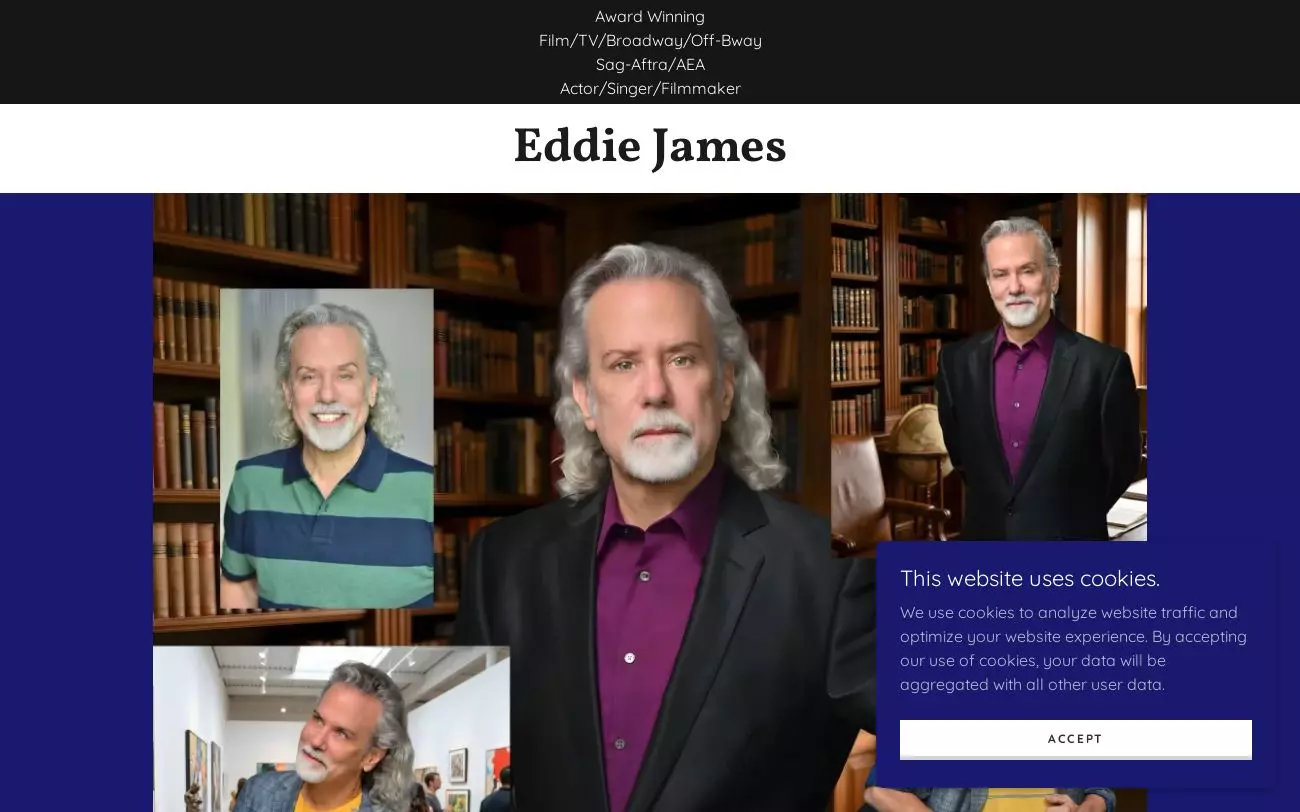 eddiejamesw.com
Built By: Unknown
#4
eddiejamesw.com
Built By: Unknown
#4
 lauriebrown.com
Built By: Unknown
#4
lauriebrown.com
Built By: Unknown
#4
 sion.com
Built By: Unknown
#9
sion.com
Built By: Unknown
#9
 alumni.princeton.edu
Built By: Unknown
#9
alumni.princeton.edu
Built By: Unknown
#9
 anastasmichos.com
Built By: Unknown
anastasmichos.com
Built By: Unknown